- Probate in Australia typically takes between 3 and 12 months, though complex or contested estates can take considerably longer
- Executors have a legal duty to administer the estate efficiently, but no fixed statutory deadline exists for completing distribution
- Beneficiaries can request an interim distribution before the estate is finalised, subject to the executor having sufficient certainty about outstanding debts and liabilities
- Inheritance advance products allow beneficiaries to access a portion of their expected share early in exchange for a fee or an agreed portion of the final inheritance
- Contested estates — including Will challenges and family provision claims — can remain unresolved for 12 to 36 months or more in Australian jurisdictions
- Legal costs for estate disputes must generally be paid from the beneficiary’s own funds unless litigation funding is in place
- Litigation funding is available for eligible estate disputes, allowing beneficiaries to pursue their entitlement without funding the proceedings personally
- Loading table of contents…
Being told that money tied up in an estate cannot be released yet is a particular kind of difficulty. The loss is still fresh. Practical pressures are already building. And the legal process, with its timelines and requirements, offers little comfort to someone who simply needs to know what comes next.
The question most people eventually ask is a practical one: what can actually be done while the estate is being administered? The answer depends on the circumstances. But the options are more varied than most people realise, and understanding them early makes a meaningful difference to how the months ahead are managed.
Why Money Gets Tied Up in an Estate
When someone dies, their assets do not transfer automatically to the people named in their Will. Before any distribution can happen, the estate must go through a formal legal process called probate — or, if no Will exists, Letters of Administration. These processes establish the validity of the Will, identify all assets and liabilities, notify creditors, and ensure the estate is distributed correctly under Australian law.
During this period, the executor or administrator holds the estate on behalf of all beneficiaries. They are legally required to ensure sufficient funds remain available to cover outstanding debts, taxes, and any claims before any money is paid out. This is not delay for its own sake. It is the legal framework governing estate administration in every Australian state and territory.
The length of the delay depends on several factors: the complexity of the estate, whether real property is involved, the number of beneficiaries, whether any claims or disputes have been lodged, and how responsive institutions such as banks and the Australian Taxation Office are during the process.
How Long Estate Administration Actually Takes in Australia
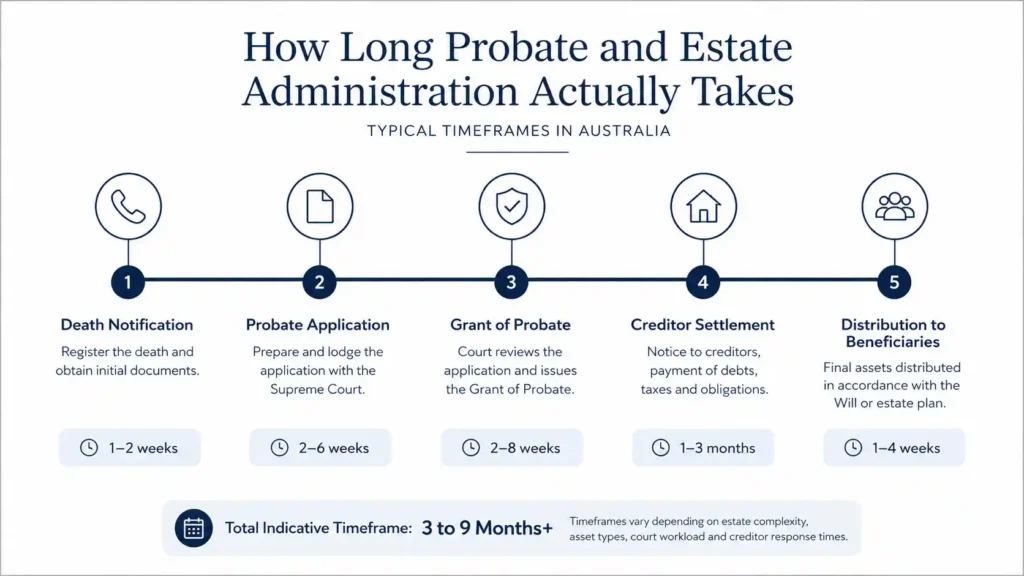
A straightforward estate with a clear Will, a small number of assets, and no disputes can move through probate in as little as three to six months. Most estates sit somewhere between six and twelve months. When additional complexity is involved — real property, business interests, superannuation requiring a binding death benefit nomination to be assessed, or assets in multiple jurisdictions — timelines extend accordingly.
| Estate type | Typical duration | Common factors extending the timeline |
|---|---|---|
| Simple estate | 3 to 6 months | Clear Will, limited assets, no disputes, no real property |
| Moderate estate | 6 to 12 months | Real property, multiple beneficiaries, superannuation to resolve |
| Complex estate | 12 to 24 months | Business interests, overseas assets, trusts, multiple jurisdictions |
| Disputed estate | 12 to 36+ months | Will contest, family provision claim, executor removal proceedings |
These timeframes apply across most Australian states. Each state has its own probate court and procedural requirements, which can affect timing. A solicitor familiar with the relevant jurisdiction can provide a more specific estimate once the estate’s circumstances are known.
Your Options When Money Is Tied Up in an Estate
There is no single approach that works in every situation. The right path depends on how much is at stake, how the estate is being administered, whether it is being contested, and what your financial position looks like in the meantime. These are the main options available to beneficiaries while money remains tied up in an estate.
- Request an interim distribution. If the executor has sufficient clarity on outstanding debts and liabilities, they may agree to release a partial payment to beneficiaries before the estate is fully wound up. This requires the executor’s cooperation and a reasonable degree of certainty about what remains outstanding.
- Use an inheritance advance product. Some providers in Australia offer advances against an expected inheritance. These are not traditional loans — they are agreements to assign a portion of the future inheritance in exchange for access to funds now. They carry fees and conditions worth reviewing carefully before proceeding.
- Take out a personal loan. Some beneficiaries borrow commercially while waiting for the estate to settle. This can work where the expected inheritance is large enough to repay the loan, but it adds interest costs and depends entirely on the beneficiary’s personal creditworthiness.
- Apply to the court for urgent orders. Where delay is causing genuine financial hardship and the executor is not acting properly, a beneficiary may be able to apply to the Supreme Court for interim orders. Legal advice is essential before taking this step.
- Explore litigation funding for a disputed matter. If the estate is being contested, litigation funding can cover legal costs so the matter can proceed without the beneficiary funding it personally. This does not provide early access to the inheritance itself, but it removes the financial barrier to pursuing or defending a legitimate entitlement.
Interim Distributions and How to Request One

An interim distribution is a partial payment made to beneficiaries before the estate administration is complete. It is not an automatic right. The executor must agree that it is appropriate, and must be confident that sufficient funds will remain to cover all debts, taxes, and any potential claims against the estate.
Where an estate is reasonably straightforward, an executor may be willing to release a proportion of each beneficiary’s expected share — often somewhere between 50 and 80 per cent — while retaining the balance as a reserve until the administration is finalised.
The process for requesting an interim distribution is more straightforward than most people expect. The general approach works as follows:
- Write to the executor formally. Request an update on the administration’s progress and ask specifically whether an interim distribution is possible given the current position of the estate.
- Allow reasonable time for a response. Executors have a duty to keep beneficiaries reasonably informed. A formal written request creates a record and signals that you are engaged in the process.
- Seek legal advice if the executor does not respond. If the executor is unresponsive or refuses without adequate reason, a solicitor can advise on the options available, including whether a court application is warranted.
- Keep records of all communications. Documenting every request and response becomes important if the matter later needs to be brought before a court.
When a Disputed Estate Delays Inheritance Access Even Further
A contested estate adds a layer of complexity that can significantly extend how long money remains inaccessible. Common disputes include challenges to the validity of the Will itself, family provision claims where someone argues they were not adequately provided for, concerns about how the executor is conducting the administration, and disagreements between beneficiaries about the sale or valuation of assets.
Once a dispute is underway, the estate generally cannot be distributed until proceedings are resolved — either through mediation or a defended court hearing. This means the delay is no longer measured in months of administration time but in the duration of the legal process, which varies considerably.
- Will validity challenges that proceed to a defended hearing in the Supreme Court can take 12 to 24 months or longer to resolve
- Family provision claims are often resolved through mediation, but when contested at hearing, 18 to 30 months is a realistic timeframe in many Australian jurisdictions
- Executor disputes may require separate proceedings for removal, adding further time before administration can resume properly
For beneficiaries in this position, the most pressing concern is often not only the delay but the cost of participating in proceedings at all. Legal fees accumulate regardless of outcome, and many beneficiaries do not have sufficient liquid funds to sustain proceedings over many months — particularly when distributions from the estate are frozen throughout.
How Juel Supports Beneficiaries in Estate Disputes

When an estate is disputed and a beneficiary’s entitlement is being contested or delayed, the financial pressure to simply accept a lesser outcome — or walk away from a valid claim — is real. For many people, that decision is not based on the merits of the case. It is based on the cost of continuing.
Juel Finance provides litigation funding for eligible estate disputes across Australia. Rather than paying legal costs from personal funds while money remains tied up in the estate, a litigation funding arrangement means those costs are covered by Juel in exchange for an agreed portion of the successful outcome. If the proceedings are not successful, the beneficiary owes nothing.
- Every application is assessed by experienced people, not automated systems or credit scoring algorithms
- Assessment focuses on the merits of the estate matter and individual circumstances, not personal financial history
- Repayment is structured to occur at resolution, not during proceedings
- There is no requirement to change legal representation or alter the legal strategy of your matter
- Legal fee payments go directly to your solicitors; Juel does not control the conduct of the matter
Litigation funding is not the right fit for every situation. Juel works with matters that have substantive legal merit, a clear anticipated resolution, and a claimant whose ability to pursue the matter is genuinely constrained by financial pressure. If you are uncertain whether your matter is eligible, a confidential initial conversation will clarify that without obligation.
Is Financial Pressure Shaping Your Decision?
If financial pressure is making the decision harder, a conversation with Juel is worth having before you commit to anything. Confidential, no obligation, assessed on the specific circumstances of your matter
Frequently Asked Questions About Money Tied Up in an Estate
The Delay Is Common. Waiting Is Not Always the Only Answer.
If your money is tied up in an estate, the delay is almost always procedural. The legal process exists to protect every party involved — including you as a beneficiary. Understanding that is the first step toward approaching the situation with clarity rather than frustration.
The second step is understanding that waiting is what many people do, not what all people have to do. Interim distributions, formal requests to the executor, inheritance advances, and litigation funding in contested matters all represent real alternatives that are worth knowing about before accepting an open-ended delay as the only path forward.
If the estate involves a dispute and the cost of participating in that dispute is the barrier, Juel Finance is one option worth considering. A conversation carries no obligation, and it may clarify whether funding is available in your specific situation — before financial pressure begins to shape a decision that deserves to be made on its merits.
Money Tied Up in an Estate: Options at a Glance
| Situation | Typical duration | Key financial pressure | Options worth considering |
|---|---|---|---|
| Simple estate, no disputes | 3 to 6 months | Waiting period before any distribution | Interim distribution request, personal bridging if needed |
| Moderate estate, no disputes | 6 to 12 months | Delay accessing distributions, ongoing costs | Interim distribution, inheritance advance product |
| Complex estate, no disputes | 12 to 24 months | Extended delay, uncertainty about timeline | Formal executor communication, legal advice, interim distributions |
| Disputed estate (Will challenge or family provision) | 12 to 36+ months | Frozen distributions, legal fees accumulating | Litigation funding to cover legal costs while distributions are unavailable |
| All eligible disputed matters | Variable | Pressure to accept inadequate outcomes or abandon valid claims | A structured litigation funding arrangement removes that pressure |
Juel Finance provides litigation funding for estate disputes and related legal matters across Australia. This article is general information only and does not constitute legal or financial advice. Please seek independent legal and financial advice appropriate to your specific circumstances.
If your money is tied up in an estate, you cannot access it directly while probate is underway. The administration process typically takes between three and twelve months in Australia, and considerably longer when the estate is disputed.